Our Process
The Law Firm Marketing Process We Run on Every Personal Injury Account
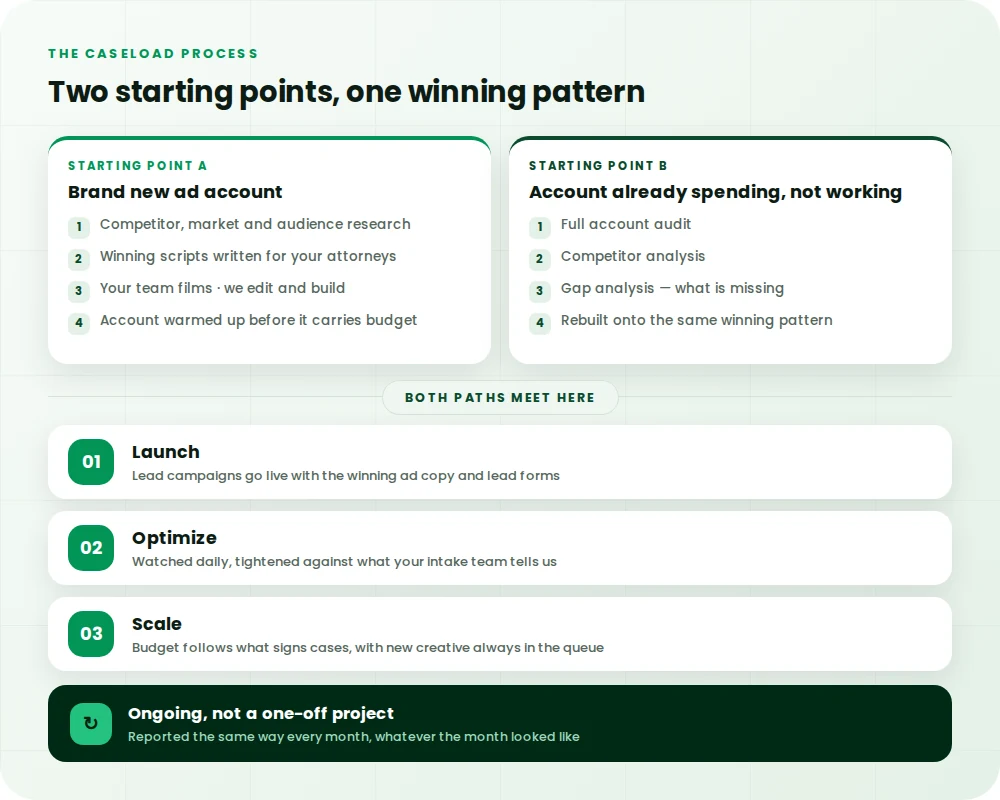
Our law firm marketing process has two starting points and one winning pattern. If your ad account is brand new, we start with research and creative. If you are already spending and it is not working, we start with an audit and a gap analysis. From there both firms follow the same path: build, launch, optimize and scale.
Personal injury firms only · Serving injury practices nationwide
2 ways in
New account or an account that stalled
1 pattern
The same build, launch and scale for both
Weekly
Account review with your team
Monthly
One report, every channel
The law firm marketing process Caseload Marketing runs on a personal injury ad account. Timings vary by firm; the order of the work does not.
What is the Caseload Marketing law firm marketing process?
It is a fixed order of work built around one idea: find what is already winning in your market, put your attorneys on camera saying it better, and only spend real money once the account is ready to carry it.
Where the law firm marketing process begins depends on what you already have. A firm opening a new ad account needs research and creative before anything else. A firm with months of spend and nothing to show for it needs to know what went wrong first, or the same mistakes get rebuilt at a higher budget.
After that first step the two paths are the same, and they do not end. Optimizing and scaling is ongoing work for as long as we run the account.
- Research before creative. We look at what is working in your market before we write a word.
- Your attorneys on camera. We write the scripts, your team films them, we do the rest.
- The account is warmed up first. A cold account is an expensive place to start a lead campaign.
- Scaling is ongoing. Not a launch and a handover — a rhythm that runs every week.
Which starting point is your firm?
Two situations, two first steps. Everything after that is the same law firm marketing process for both.
Starting point A
A brand new ad account
You have never run paid social, or the account exists but has never spent. There is no history to learn from, so we build the picture from the market instead.
We start with: competitor, market and audience research.
Starting point B
An account that is spending but not working
You have been running ads, the cost per lead has climbed, or the leads are not turning into cases. There is history here, and it is worth reading before touching anything.
We start with: an audit, a competitor analysis and a gap analysis.
Starting point A
A brand new ad account
With no spend history to read, we build the plan from the market: who else is advertising to injured people in your area, what they are saying, and what is already getting attention.
Nothing in this half of the law firm marketing process is guesswork, and none of it is a template. Two firms in the same city get two different plans because their markets, their competitors and their attorneys are different.
- Market and competitor research. Who is advertising against you, what they are running and where the gaps are, using the Meta Ad Library and the data in your market.
- Target market analysis. Who we need to reach, where they are, and what actually makes an injured person pick up the phone.
- Top-performing creative analysis. The ad formats and angles already winning in personal injury, so we start from what works rather than from a blank page.
- Scripts written for your attorneys. Our team writes them. They are yours, written for your practice areas and your voice, ready to shoot.
- Your team films, we edit. You shoot the scripts and send the footage back. We cut it into the formats that perform on Meta.
- Campaign build. Ad copy and lead forms written to pull in the right cases and screen out the ones you do not want, and checked against ABA Model Rule 7.1 before anything is submitted.
- Account warm-up. Engagement, traffic and reach campaigns run alongside the launch so the account is not cold when the lead campaigns start carrying budget.
- Lead generation goes live. The main campaigns launch into an account that is already active, with creative and copy that were chosen, not guessed.
What you get at the end: an ad account that is live, warm and running creative built specifically for your firm — not a recycled campaign with your logo on it.
Starting point B
An account already spending, but not working
Before we change anything we find out what went wrong, because rebuilding a campaign on top of the same problem just makes the problem more expensive.
This half of the law firm marketing process is free and you keep the findings. Some of the accounts we review do not need an agency, they need one thing fixed. When that is the case we say so.
- Account audit. Structure, budgets, creative, forms and what the account has actually been producing, month by month, inside Meta Ads Manager.
- Competitor analysis. What the firms winning in your market are running right now, and how your ads compare beside them.
- Gap analysis. The difference between the two, in plain language: what is missing, what is working against you, and what is fine and should be left alone.
- Findings, in writing. A prioritized list of what is costing you cases today, including anything running that would not pass ABA Model Rule 7.2 — yours to keep whether or not you work with us.
- Then the same winning pattern. New scripts, your attorneys on camera, edited creative, rebuilt ad copy and lead forms, and a relaunch into an account that has been cleaned up first.
What you get at the end: a straight answer about why the account is underperforming, and a rebuild that follows the same pattern as a brand new account rather than a patch over the old one.
Where both paths meet: launch, optimize, scale
From launch onward there is no difference between the two starting points. This is the part of the law firm marketing process that never finishes.
01
Launch
Lead campaigns go live with the ad copy and lead forms we built, into an account that has already been warmed up. Every lead is routed to your CRM with the campaign attached and alerted to your team the moment it lands.
02
Optimize
Watched daily in the early weeks. Creative that is not pulling gets replaced, the winning angle gets more room, and the form is tightened wherever people are dropping out. Your intake team tells us which leads were real, and that feedback drives the changes.
03
Scale
Budget moves toward what is signing cases, in steps, watching cost per lead at each one. New scripts and new creative are always in the queue, because the first sign of a coming cost increase is creative that has been running too long.
Optimizing and scaling is ongoing for as long as we run the account. It is not a launch and a handover.
Why does the order matter?
Every step of our law firm marketing process exists because we watched the alternative cost a firm money. This is what goes wrong when a law firm marketing process starts in the middle.
Creative without research is guesswork
Personal injury is one of the most competitive auctions on Meta. If you have not looked at what is already winning in your market, you are paying to find out the slow way.
A cold account is expensive
Launching lead campaigns into an account with no activity behind it costs more per lead and takes longer to settle. Warming it up first is cheaper than learning this at scale.
Rebuilding without an audit repeats the mistake
If the leads were not reaching the CRM, or the form was letting the wrong claims through, a new campaign on top of it produces the same result at a higher budget.
Stock footage does not sign cases
Injured people hire an attorney they have seen and believed. That is why your attorneys are in the videos and why we write scripts instead of licensing a stock library.
Scaling too early hides the truth
A few weeks of data at a large budget tells you less than a longer run at a controlled one, and costs several times as much to find out.
Adding channels too early splits focus
Newsletters, direct mail and AI intake all work better once paid social is producing predictable volume. They come on one at a time, not on day one.
What does a law firm get from us every month?
The law firm marketing process ends every month the same way: the same report, in the same format, whether the month was good or bad. We would rather explain a soft month than dress one up.
Spend, leads and cost per lead
Per campaign and per channel, with the previous month beside it so the direction is obvious at a glance.
What intake did with them
Leads called, leads reached, consultations booked and, where your CRM tracks it, cases signed. This is the number that decides where budget goes next.
Creative performance
Which hooks and which case types are producing, which are tiring, and which scripts are being written to replace them.
What we changed
Every meaningful change we made during the month and why, so nothing that happens to your account is a surprise.
What we are changing next
The plan for the coming month, agreed with you rather than announced to you.
The honest part
If something did not work, it is in the report with what we think went wrong. Nobody learns anything from a report that only contains good news.
Our published results come from the same reporting. You can read them in the law firm marketing case studies, account by account.
What does your firm have to do?
Two things really matter: your attorneys have to get in front of a camera, and your team has to call the leads quickly. The law firm marketing process only works if both happen.
The law firm marketing process leans on your side more than most firms expect. The ones that get the most out of us are not the ones with the biggest budgets. They are the ones whose attorneys film the scripts on time and whose intake team tells us the truth about lead quality.
- Film the scripts. We write them. Your attorneys shoot them on a phone or a camera and send the footage back. This is the single biggest thing your firm controls.
- Access, once. Ad account, page, CRM and reporting, at the start.
- An approver. One person who can sign off creative without a committee.
- Fast intake. New leads called in minutes during office hours — and covered after hours, by your team or by an AI agent.
- Outcome feedback. Which leads were real, and which signed. Even roughly, monthly, by email.
- Half an hour a week. The weekly call. That is the whole time commitment.
The process in practice
What it looks like when the pattern runs
New Jersey Personal Injury Law Firm came to us with an account that was spending but could not say what it was producing — starting point B of the law firm marketing process. The tracking was rebuilt first, then the creative. Twenty-nine months later the account has delivered more than 2,890 leads on over $426,000 of managed spend, and the reporting has not had a gap since.
Which personal injury cases does this process run for?
We work with personal injury attorneys and firms across the United States, and nothing else. The law firm marketing process is identical for all of them; what changes is the research, the scripts and the questions on the form.
Car and auto accidents
The highest-volume case type on paid social, and the one where intake speed decides who signs the client.
Truck and commercial vehicle
Lower volume, higher value, and worth its own scripts, its own campaign and its own escalation rules.
Motorcycle accidents
A distinct audience and a distinct message, which is why we run it separately rather than folding it into auto.
Slip, trip and fall
Premises cases need the property, the incident report and the photographs captured early, so the form does more work here.
Rideshare, pedestrian and bicycle
Urban case types where the insurance question changes the value of the claim, and the form asks it up front.
Wrongful death and catastrophic injury
Different scripts, a different tone, and routed to a person immediately rather than into a sequence.
Nursing home negligence, dog bites, medical malpractice and mass tort claimant intake run through the same process. If it is a personal injury case, we market for it.
Which channel does the process start with?
The law firm marketing process almost always starts with paid social, because it is the fastest way to find out what your market responds to. The other four are added later, one at a time.
01
Meta ads
Facebook and Instagram lead generation. Where nearly every firm starts, and where the research and creative work pays off fastest.
02
Email & newsletters
The monthly newsletter that keeps your firm in front of everyone who enquired and did not sign.
03
AI voice agents
Added when the leads are arriving outside office hours and reaching voicemail instead of a person.
04
Direct mail
Tracked mail into the neighborhoods and case types your paid campaigns already proved out.
05
ChatGPT ads
The newest channel, tested with a small budget beside what is already working rather than instead of it.
06
Everything together
One agency, one report, one law firm marketing process across every channel your firm runs.
Law firm marketing process: FAQs
The questions personal injury attorneys ask us most about the law firm marketing process and how we work.
What is your law firm marketing process?
Our law firm marketing process has two starting points. A firm with a brand new ad account enters the law firm marketing process with competitor, market and audience research, then scripts written by our team and filmed by your attorneys, edited creative, ad copy and lead forms, an account warm-up and the lead campaign launch. A firm already spending without results starts with an audit, a competitor analysis and a gap analysis, and then follows exactly the same pattern. After launch both are the same: optimize and scale, ongoing.
We have never run ads before. Where do we start?
With research. Because there is no spend history to read, we build the plan from your market instead: who else is advertising to injured people in your area, what they are running, who we need to reach and which creative angles are already performing in personal injury. Everything after that is built on what the research found.
We are already spending and it is not working. What happens first?
An audit, a competitor analysis and a gap analysis, before anything is changed. We look at what the account has actually produced month by month, what the firms winning in your market are running, and the difference between the two. You get the findings in writing and you keep them either way.
Who writes the video scripts?
We do. Our team writes the scripts based on the research, your practice areas and the angles already working in personal injury advertising. They are written for your attorneys to say in their own voice, not read off a card.
Who films the videos?
Your attorneys do. You shoot the scripts we send and give us the footage back, and we edit it into the formats that perform on Meta. It is the one part of the process your firm has to do, and it is the part with the biggest effect on results. Firms that film on time get moving faster than firms that do not.
Do we need a professional video crew?
No. A phone in good light and a quiet room is enough for most of what we run. Injured people respond to an attorney who looks real and sounds like they know the case, and over-produced footage often performs worse than something simple and direct.
What is an account warm-up and why does it matter?
Before and alongside the main lead campaigns we run engagement, traffic and reach campaigns so the account is active rather than cold when the lead campaigns start carrying budget. A cold account costs more per lead and takes longer to settle, so warming it up first is simply cheaper.
Who approves the ads before they go live?
Your firm does, always. Scripts, ad copy, creative and form questions come to you before anything is published. We also check every claim and comparison against the ABA Model Rules on lawyer advertising and your state bar’s rules first, but the final approval is yours because the advertising is yours.
How do you decide when to increase budget?
By what happens in your CRM, not what happens in the ads dashboard. If a campaign is producing leads your intake team reaches and books, we scale it in steps and watch cost per lead at each one. If it is producing cheap leads nobody signs, we do not scale it, however good the cost per lead looks.
Does the process ever end?
No. Optimizing and scaling is ongoing for as long as we run the account: new scripts, new creative, budget moving toward what is signing cases, and a weekly call with your team. The build is a project, the rest is a rhythm.
What happens if the campaign does not work?
We say so in the monthly report, with what we think went wrong. Usually it is the creative or the intake rather than the targeting, and both are fixable. What we will not do is quietly move budget somewhere else and hope you do not notice a flat month.
Do you work with firms outside personal injury?
No. Caseload Marketing works with personal injury attorneys and law firms across the United States only. The research, the scripts, the intake questions and the advertising rules are specific enough that doing several practice areas well is not realistic, so we picked one.
Start with a free account review
Tell us whether your ad account is brand new or already spending, and we will show you what the first step of our law firm marketing process looks like for your firm. If you are already running ads, you keep the findings whether or not we work together.