ChatGPT Ads · Advertising in AI answers
ChatGPT Ads for Law Firms: Be the Firm People Find When They Ask AI for a Lawyer
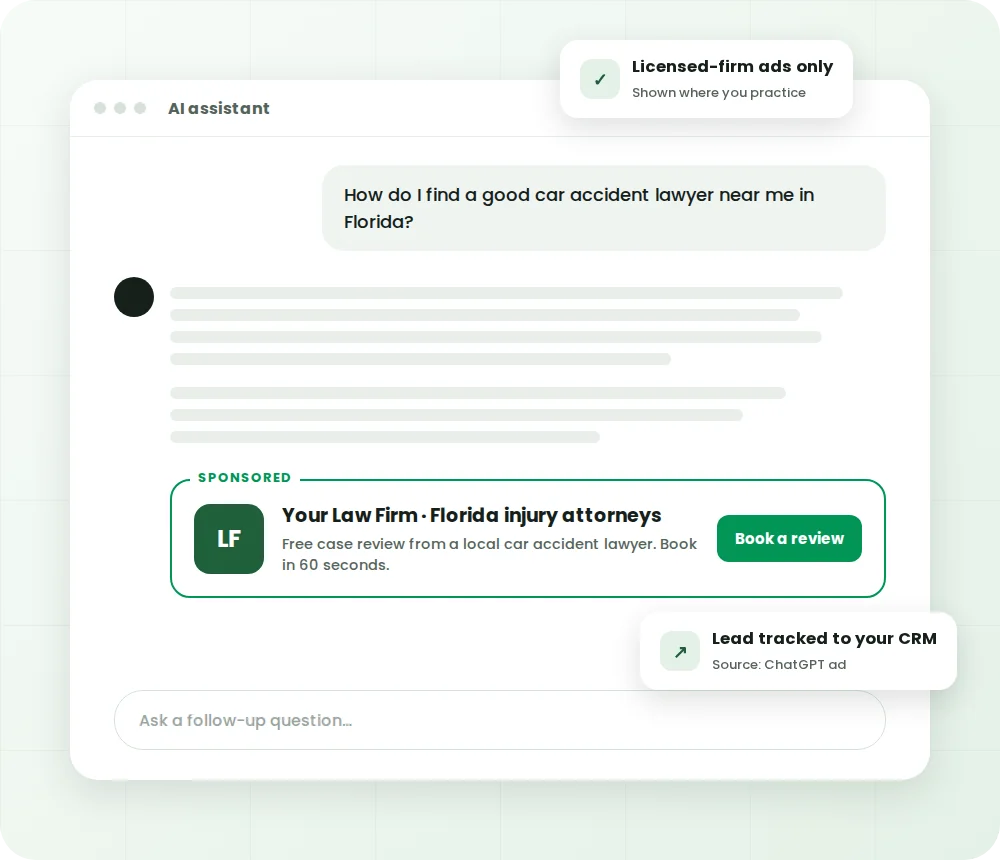
Caseload Marketing runs ChatGPT ads for law firms: sponsored placements that appear below ChatGPT’s answers when people in your area ask about the legal problems your firm handles. OpenAI now allows licensed US law firms to advertise in ChatGPT, and we plan, write, launch and track these campaigns alongside your Meta ads, email and intake.
AI advertising for attorneys & law firms · Serving firms nationwide
2026
Year ChatGPT opened advertising to US law firms
Free & Go
ChatGPT plans that see ads
18+
Adult users only
CPC · CPM
Pay per click or per 1,000 views
Sources: OpenAI Help Center, OpenAI ad policies and OpenAI, checked September 2026.
What are ChatGPT ads, and how do they work?
ChatGPT ads are sponsored placements that appear below the end of a ChatGPT answer, clearly labelled and separate from the answer itself. Each ad shows the advertiser’s name, a headline, a short description, an image and a link. Instead of bidding on keywords, advertisers describe the kinds of conversations their ad fits, and ChatGPT shows the ad when a conversation matches.
OpenAI is clear that ads do not change ChatGPT’s answers: they run on separate systems, and advertisers cannot shape or rank a response (OpenAI Help Center). For ChatGPT ads for law firms, that means the ad earns attention by being the most relevant, helpful next step under the answer.
- Shown below the answer. Labelled “Sponsored” and visually separate from ChatGPT’s response.
- Matched to the conversation. Ads are selected by conversation context, not by keyword lists.
- Adults on Free and Go plans. Plus, Pro, Business, Enterprise and Edu accounts see no ads, and neither do users under 18.
- Pay per click or per view. OpenAI supports cost-per-click and cost-per-thousand-impression bidding.
Can law firms advertise on ChatGPT?
Yes, in the United States. OpenAI’s ad policies permit ads for legal services in the US when the advertiser is licensed to practise law in the jurisdiction where the ad is shown. Here is what that means for ChatGPT ads for law firms.
Licensed where the ad shows
Your ads can only run in the states where your attorneys are licensed. We map every campaign to your firm’s jurisdictions.
US only
Legal services ads are not permitted outside the United States, so every campaign targets US users.
No ads in sensitive moments
ChatGPT does not show ads near personal health, mental health, politics or other sensitive conversations.
Adults only
Ads are never shown to accounts identified as under 18.
Bar rules still apply
Every ChatGPT ad must also follow your state bar’s advertising rules, most of which are based on ABA Model Rule 7.1.
Policies are still changing
OpenAI has updated its ad policies several times in 2026. We track every change so your campaigns stay approved.
Why should law firms run ChatGPT ads now?
People already ask ChatGPT the questions they used to type into Google, often in far more detail. ChatGPT ads for lawyers put your firm in front of them at that moment, while the channel is still new.
01
Detailed, high-intent questions
People describe their situation in full sentences, so the conversation tells you far more about what they need than a three-word search.
02
Early-mover advantage
Legal ads were only permitted in 2026. Firms that learn the channel now will be ahead when competition arrives.
03
A new audience
Many people who use ChatGPT every day rarely click search ads. This reaches them where they already ask for help.
How does Caseload Marketing run ChatGPT ads for law firms?
Our ChatGPT ads for law firms follow the same eight-point playbook we use on Meta: built for intake, tracked to signed cases and reviewed every week.
01
Eligibility and setup
We set up your OpenAI Ads Manager account and match every campaign to the states where your attorneys are licensed.
02
Conversation mapping
We turn the real questions your clients ask into the conversation contexts that decide when your ad appears.
03
Ad copy for conversations
Plain, helpful headlines and descriptions that read as the natural next step after an answer, checked against bar rules.
04
Landing pages that match
Each ad leads to a page that answers the same question and makes it easy to call or book.
05
Tracking from day one
Tagged links, call tracking and CRM sync, so every ChatGPT lead is labelled and reaches your team instantly.
06
Smart bidding
We start on cost-per-click so you pay for visits, then test cost-per-impression where it lowers your cost per lead.
07
Weekly optimisation
Contexts, copy and budgets are adjusted every week on live results while the platform matures.
08
Reporting on cases
ChatGPT results sit in the same plain-English report as your Meta ads and email, measured on cost per signed case.
How do we launch ChatGPT ads for your firm?
Four steps, starting with a small test budget so you learn what works before you scale.
- Plan. We confirm eligibility, pick the practice areas and states to start with, and map the questions your clients ask.
- Build. Ads Manager account, conversation contexts, ad copy, landing pages and tracking.
- Test. A controlled launch on cost-per-click, with weekly changes to contexts, copy and budget.
- Scale. Budget moves to the campaigns that produce signed cases, reported alongside your other channels.
ChatGPT advertising is new and still rolling out, so we set expectations for a learning period before judging results.
What does a ChatGPT ad for a personal injury law firm look like?
Personal injury is where ChatGPT ads for law firms fit best, because accident victims ask AI exactly what happened to them and what to do next. Here are six examples, one for each type of case, each answering the question the person just asked.
Car accident
Rear-ended? Find out what your claim is worth
Free case review from a car accident attorney licensed in your state. Talk to someone today, no fee unless you win.
Conversation context: someone describing a rear-end or intersection crash and asking whether they need a lawyer
Truck accident
Hit by a truck? Evidence disappears fast
Trucking companies send investigators within hours. Get a free review from a truck accident lawyer before the evidence is gone.
Conversation context: someone asking what to do after a crash with an 18-wheeler or delivery truck
Motorcycle accident
Motorcycle crash? Do not accept the first offer
A motorcycle accident attorney will review your case free and explain what your claim may really be worth.
Conversation context: someone asking about fault, insurance or medical bills after a motorcycle crash
Slip and fall
Fell on someone else’s property? You may have a case
Free review from a premises liability attorney. Find out in minutes whether the property owner is liable.
Conversation context: someone asking whether a store or landlord is responsible for a fall
Rideshare accident
Crash in an Uber or Lyft? Insurance is complicated
A rideshare accident lawyer explains which policy covers you, and handles the claim for you. Free consultation.
Conversation context: someone asking who pays after a crash in an Uber or Lyft
Wrongful death
Lost a loved one in an accident? Know your family’s options
A wrongful death attorney licensed in your state will explain your rights in a free, private consultation. No pressure.
Conversation context: someone asking what a family can claim after a fatal accident
Every example is written to your state bar’s advertising rules, and to OpenAI’s. Claims such as “no fee unless you win” only run where they are accurate and permitted, and ads never appear in conversations ChatGPT treats as personal health.
Which personal injury cases should you test on ChatGPT first?
ChatGPT ads for law firms work where claimants research before they call, and injury claimants research constantly. These are the case types we would test first.
Car accidents
People ask what to do after a crash, whether they need a lawyer and how a claim actually works, often within hours of the accident.
Truck & commercial vehicle
Longer, more detailed questions about liability, insurers and employers, which is exactly the kind of conversation the assistant handles.
Slip, trip and fall
Claimants ask whether a property owner is responsible before deciding whether the injury is worth a call.
Rideshare accidents
Uber and Lyft claims confuse people, and confusion is what sends them to an assistant rather than a search engine.
Nursing home negligence
Families research quietly, over days, before anyone contacts a lawyer.
Wrongful death
Sensitive, considered questions asked in private, where a calm answer and a clear next step matter more than a clever ad.
ChatGPT ads work best as part of a full system. Pair them with our Facebook ads for law firms, email follow-up and AI voice agents, all run by one law firm marketing agency. See how we run an account, or read about Caseload Marketing.
Early access
Be one of the first law firms in your market on ChatGPT
Legal advertising in ChatGPT is brand new, and few firms know how to use it yet. Caseload Marketing is building ChatGPT campaigns for law firms now, with the same tracking and intake focus behind our Meta results.
- Eligibility check and campaign plan for your states
- Conversation contexts built from your clients’ real questions
- Landing pages and tracking ready before launch
- One report across ChatGPT, Meta and email
ChatGPT ads for law firms: FAQs
Answers to the questions attorneys ask us most about advertising in ChatGPT.
What are ChatGPT ads?
ChatGPT ads are sponsored placements that appear below the end of a ChatGPT answer. They are labelled as sponsored, visually separate from the response, and show the advertiser’s name, a headline, a description, an image and a link.
Can law firms advertise on ChatGPT?
Yes, in the United States. OpenAI’s ad policies allow ads for legal services in the US when the advertiser is licensed to practise law in the jurisdiction where the ad is shown (OpenAI ad policies). Legal services ads are not permitted outside the US.
How much do ChatGPT ads cost for a law firm?
ChatGPT ads are sold by auction, on either cost per click or cost per thousand impressions. OpenAI does not publish fixed prices, so costs depend on your market, practice area and competition. We start ChatGPT ads for law firms with a controlled test budget and report cost per lead and cost per signed case.
Who sees ads in ChatGPT?
Adult users on ChatGPT’s Free and Go plans. Plus, Pro, Business, Enterprise and Edu accounts do not see ads, and OpenAI does not show ads to accounts identified as belonging to users under 18.
Do ChatGPT ads change ChatGPT’s answers?
No. According to OpenAI, ads run on separate systems from the chat model, and advertisers cannot shape, rank or alter ChatGPT’s responses. Your ad appears below the answer, not inside it.
How do you target ChatGPT ads without keywords?
Instead of buying keywords, advertisers describe the conversation contexts their ad is relevant to. We build those contexts from the real questions your clients ask, by practice area and state, and refine them every week.
Will my ad appear in sensitive conversations?
No. OpenAI does not show ads near personal health, mental health, politics or other sensitive conversations, or in conversations where a user may be vulnerable.
Do bar advertising rules apply to ChatGPT ads?
Yes. A ChatGPT ad is lawyer advertising like any other, so it must follow your state bar’s rules, which are mostly based on ABA Model Rule 7.1 on false or misleading communications (read Rule 7.1). We review every ad before it runs.
Should we run ChatGPT ads instead of Facebook ads?
No. ChatGPT ads are new and still scaling, while Meta ads already deliver leads at volume for our clients. We recommend testing ChatGPT ads alongside your Facebook ads and email follow-up, then moving budget to whichever produces signed cases most efficiently.
How do you track leads from ChatGPT ads?
Every one of our ChatGPT ads for law firms uses tagged links and call tracking, and every lead is labelled “ChatGPT” in your CRM or pipeline. You get instant alerts by text, email and Google Sheets, and ChatGPT results appear in the same monthly report as your other channels.
Get your firm into ChatGPT before your competitors do
Book a free ChatGPT ads consultation. We will check your eligibility, map the questions your clients are asking and show you how ChatGPT ads for law firms would work for your practice.