How Law Firms Get Recommended by ChatGPT and AI Search
Caseload MarketingOctober 28, 2026
Author: Caseload Marketing
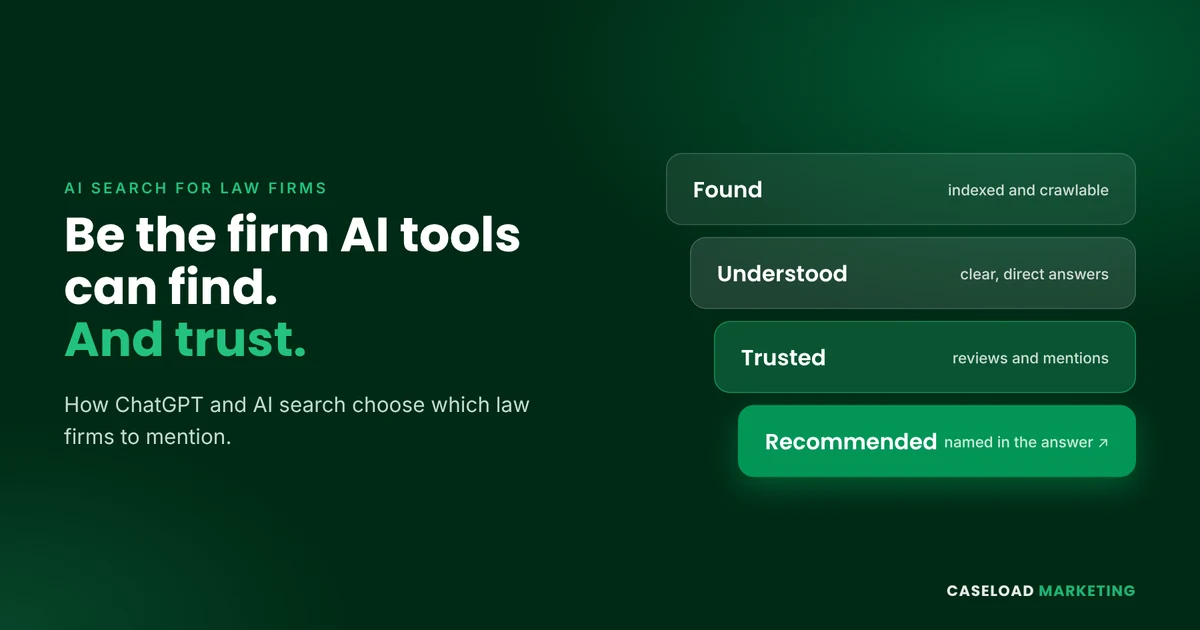
AI search tools like ChatGPT, Google AI Overviews, Gemini, Perplexity and Copilot recommend law firms they can find, understand and trust. They draw on search indexes, the firm’s own website, reviews and mentions across the web. Firms that answer questions clearly, describe themselves the same way everywhere and keep earning real reviews give these tools the most to work with.
More people now ask an AI tool a question before they ever open a search results page. Someone hurt in a crash might type “do I need a lawyer after a car accident” into ChatGPT, or see an AI Overview at the top of Google before any website link.
For personal injury firms, that raises a new question: when an AI tool answers, does it mention your firm?
This guide to law firm AI search explains how AI tools find information about law firms, what makes a firm easier to recommend, and how to check whether it is working. It is written for personal injury firms, but most of it applies to any practice.
How do AI search tools decide which law firms to mention?
AI search tools do not keep a list of approved law firms. When someone asks a question, the tool searches for current information, reads what it finds, and writes an answer. If the answer includes firms, it names the ones that appear clearly and consistently in the sources it read.
That means a firm is not “submitted” to ChatGPT or Google AI Overviews. It earns a place in the answer by being easy to find, easy to understand and well supported by other sources.
No firm can guarantee a mention. Answers change from one question to the next, and from one day to the next. What a firm can control is how much clear, accurate information it gives these tools to work with.
Where do AI tools get information about a law firm?
Most AI search tools build their answers from a few kinds of sources.
Search indexes. Google AI Overviews, AI Mode and Gemini draw on Google’s index. ChatGPT search uses its own crawler, OAI-SearchBot, together with partner search providers, including Microsoft’s Bing, which also powers Copilot. Perplexity runs its own crawler alongside other sources. If a page is not indexed, it is unlikely to be used.
The firm’s own website. Practice area pages, FAQs, attorney bios and articles tell the tool what the firm does and where it works.
Reviews and business profiles. Google Business Profile, legal directories and review sites show that real clients have worked with the firm.
Mentions across the web. News stories, community sites, bar association pages and discussions on sites like Reddit help confirm that a firm is real and active.
Four places AI search tools learn about a law firm.
Source
What it tells the AI tool
Search index (Google, Bing)
Which pages exist and what they cover
Your website
Your practice areas, locations and answers to common questions
Reviews and profiles
That real clients trust your firm
Mentions elsewhere
That other people talk about your firm
What makes a law firm easier for AI search to recommend?
Answer real questions in plain language
AI tools look for direct answers. A page headed with a question like “What should I do after a truck accident?” and followed by a short, clear answer in its first sentences is easy for a tool to quote. Long, vague pages are harder to use.
Describe the firm the same way everywhere
Your firm’s name, practice areas and location should read the same on your website, Google Business Profile, directories and social profiles. Consistent details make it easier for an AI tool to connect them and trust them.
Keep earning real reviews
Reviews on Google and trusted legal directories are one of the clearest signals that a firm helps real people. Ask happy clients for reviews in a way that follows your state bar’s rules.
Use structured data
Structured data, such as Organization, LegalService and FAQ markup, labels key facts on your pages in a format machines read easily. Google says no special markup is needed to appear in AI Overviews or AI Mode, so treat it as a helpful extra, not a shortcut. Whatever you add should match the text visible on the page.
Make sure AI crawlers can read the site
Check that your robots.txt file does not block the search and AI crawlers you want reaching your pages, such as Googlebot, Bingbot, OAI-SearchBot and PerplexityBot. Some firms also add an llms.txt file, a short plain-text summary of the site and its key pages. Google says it does not need files like this, so it is optional.
Keep content current
Pages with a clear “last updated” date and current information are easier to trust. Refresh your most important pages when laws, services or details change.
In the prompt checks we run for our own site, the pages AI tools cite are the ones that open with a direct answer to the question asked. Clear answers and consistent details do most of the work in law firm AI search.
What should a firm check first for law firm AI search?
Every main practice area has its own page with a clear, question-style heading and a direct answer near the top.
Each page has a short FAQ section answering the questions clients actually ask.
Your firm name, address, phone number and practice areas match on your site and every profile.
Your site is indexed in Google Search Console and Bing Webmaster Tools.
robots.txt does not block the search and AI crawlers you want.
Any structured data matches the visible text and passes Google’s Rich Results Test.
Your Google Business Profile is complete and you keep earning reviews.
Seven things to check first.
How can a firm tell if AI tools mention it?
Run prompt checks. Ask ChatGPT, Gemini, Perplexity, Copilot and Google the questions your clients ask, such as “best car accident lawyer in [city].” Note whether your firm is named or linked. Repeat every few weeks, since answers change.
Watch AI traffic in GA4. Visits from ChatGPT, Perplexity, Gemini and Copilot can be grouped into their own channel so you can see them grow.
Check Bing Webmaster Tools. Bing’s AI Performance report shows how often your pages are cited in Microsoft’s AI answers, including Copilot.
Look at Search Console. Visits from Google AI Overviews and AI Mode are counted in the Performance report under Web search. Longer, conversational questions there are often the same questions people ask AI tools.
What AI search does not change
AI search adds a new place to be found. It does not replace the basics.
Your state bar’s advertising rules still apply to everything you publish, including articles written to be quoted by AI tools. Claims about results, specialization and testimonials follow the same rules as any other advertising. This is general information, not legal advice.
It also does not replace the channels that already bring in cases. Facebook and Instagram ads still reach people before they start searching, and email marketing for law firms keeps past clients and referral sources close. AI search works best as one part of a full marketing plan.
How Caseload Marketing approaches law firm AI search
Caseload Marketing runs Facebook ads for law firms and email marketing for personal injury firms nationwide. We apply the same AI search basics to our own site that we recommend to firms: question-led pages with direct answers, FAQ and organization structured data, consistent profiles and regular prompt checks across the major AI tools. Learn more about our law firm marketing, or read our guide to personal injury lead generation.
Key takeaways
AI search tools recommend firms they can find, understand and trust.
Google AI Overviews, AI Mode and Gemini draw on Google’s index; ChatGPT search uses its own crawler plus partners such as Bing, which also powers Copilot.
Clear answers, consistent details everywhere and real reviews make a firm easier to recommend.
Check that robots.txt lets the crawlers you want reach your site.
Track mentions with regular prompt checks, GA4’s AI traffic and Bing Webmaster Tools.
Bar advertising rules apply to everything you publish.
Frequently asked questions
Can a law firm pay to be recommended by ChatGPT?
No. OpenAI is testing ads for some ChatGPT users, but ads appear below the answer, are clearly labeled and, according to OpenAI, do not influence what ChatGPT says. A firm can make itself easier to recommend by publishing clear answers, keeping its details consistent and earning real reviews.
How does ChatGPT find law firms?
When ChatGPT searches the web, it uses its own crawler, OAI-SearchBot, together with partner search providers such as Microsoft’s Bing. OpenAI says sites must allow OAI-SearchBot to be eligible, and placement is not guaranteed. Pages that are crawlable, easy to read and supported by reviews and mentions elsewhere give it the most to work with.
What are Google AI Overviews?
AI Overviews are AI-written summaries that appear at the top of some Google results, linking to the pages they draw on. Google says a page must be indexed and eligible to show a snippet to be used as a source, with no extra requirements.
Does SEO still matter for AI search?
Yes. AI search tools rely on search indexes, so pages that are crawlable, indexed and clearly written are the starting point for being mentioned.
What is an llms.txt file?
It is a short plain-text file at the root of a website that summarizes the site and lists its key pages for AI tools. It is optional: Google says it does not need AI text files, and the file works alongside, not instead of, a well-built site.
How long does it take to show up in AI answers?
There is no fixed timeline. New pages need to be crawled and indexed first, and AI answers change often. Firms usually track progress over months, not days.
Do reviews affect AI recommendations?
Reviews are one of the main ways AI tools can tell that a firm serves real clients well. Consistent, recent reviews on Google and trusted directories help.
Do bar advertising rules apply to content written for AI search?
Yes. Articles, FAQs and pages written to be quoted by AI tools are still attorney advertising and should follow your state bar’s rules. This is general information, not legal advice.
Last updated: October 28, 2026. This article is general marketing information for law firms, not legal advice.
Book a free account review. We will look at your ad account, creative, intake and tracking, and tell you what we would change, whether or not you work with us.
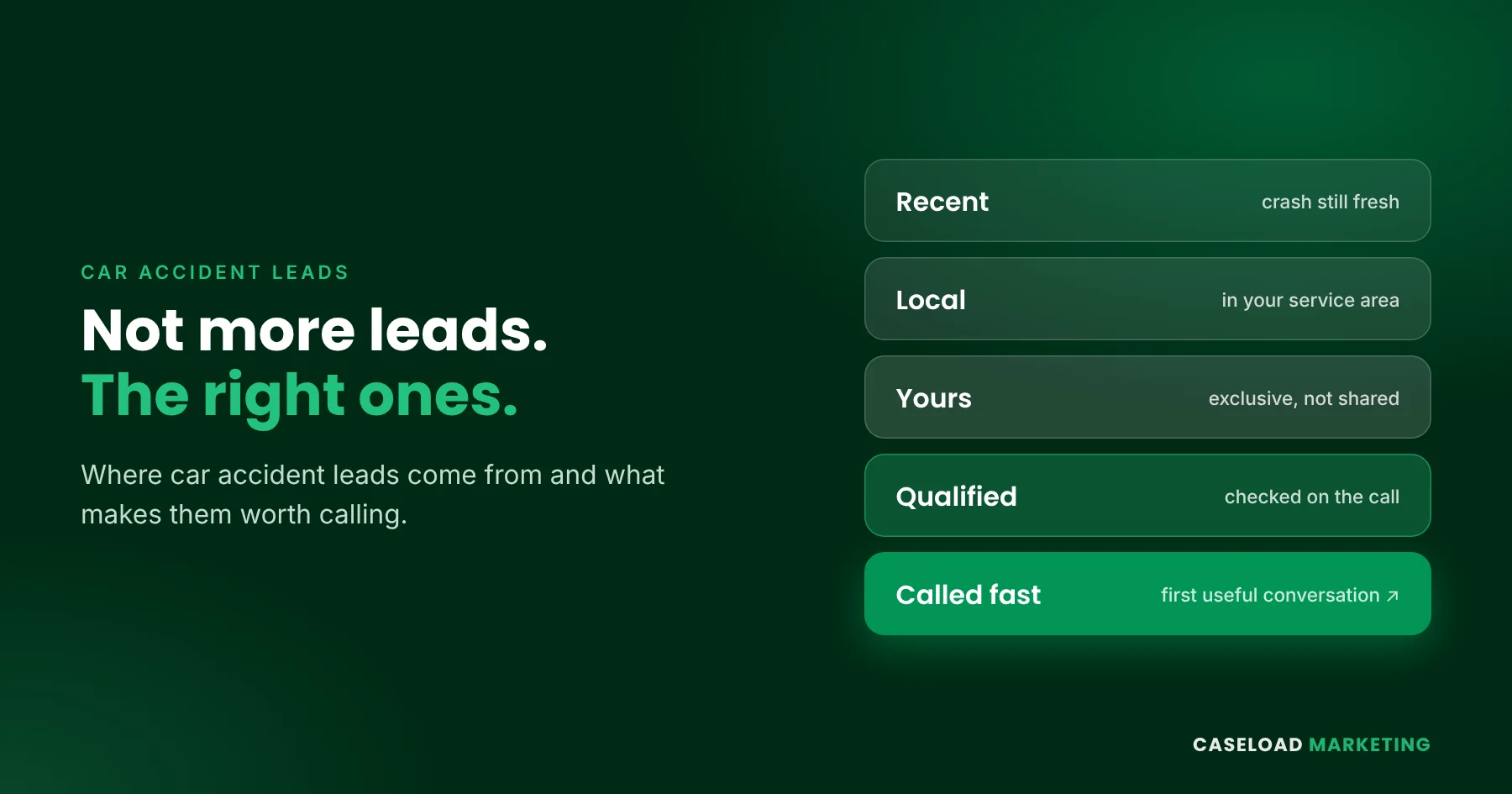
Car accident leads are people who were hurt in a crash and reached out to a law firm, by form, call or message, about a possible claim. They come from ads, search, referrals and lead vendors. The car accident leads worth the most are recent, in the firm’s service area, generated by the firm itself or exclusive to it, and called back quickly by an intake team that knows what to ask.
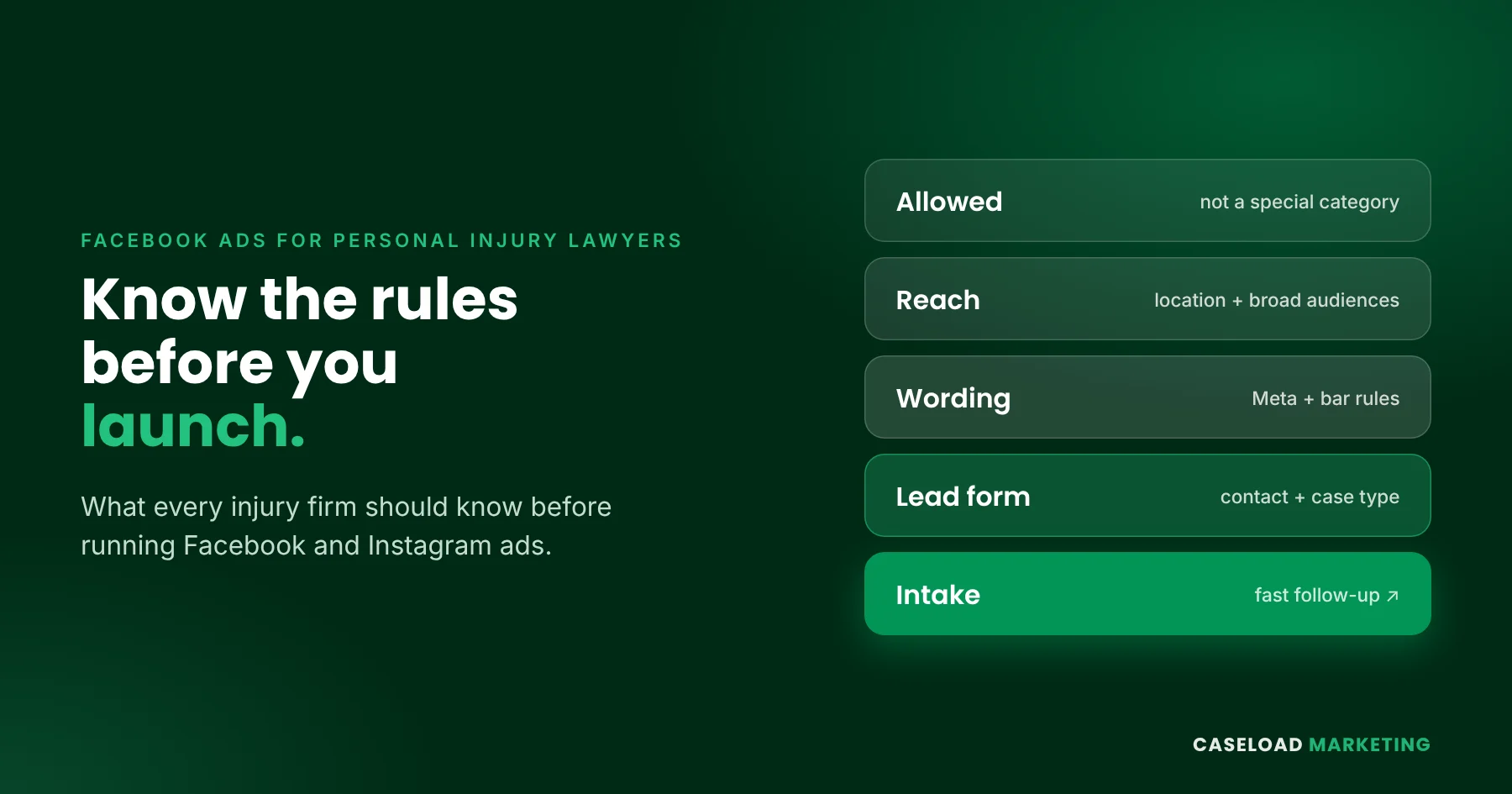
Facebook ads for personal injury lawyers work best when they reach people in the firm’s area before those people start searching, follow both Meta’s ad policies and the state bar’s advertising rules, and send every inquiry to an intake team that answers fast. Location, compliant wording, a simple lead form and quick follow-up matter more than clever creative.
AI search tools like ChatGPT, Google AI Overviews, Gemini, Perplexity and Copilot recommend law firms they can find, understand and trust. They draw on search indexes, the firm’s own website, reviews and mentions across the web. Firms that answer questions clearly, describe themselves the same way everywhere and keep earning real reviews give these tools the most to work with.
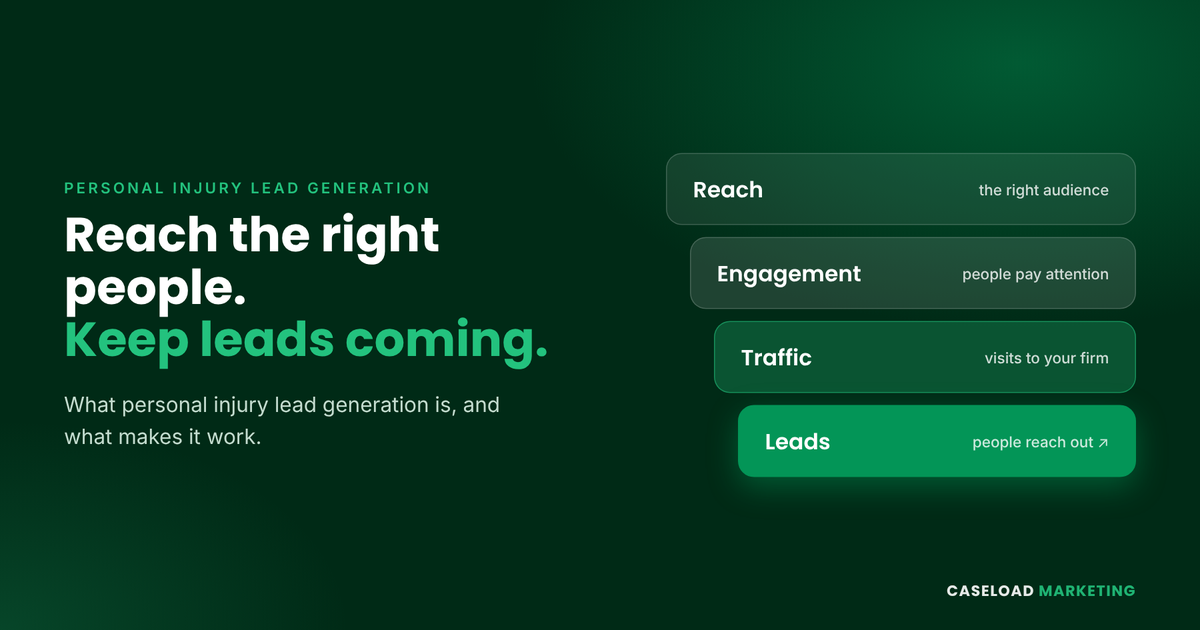
Personal injury lead generation is how a law firm reaches people hurt in an accident and gives them an easy way to get in touch. The strongest programs combine broad reach, messages that speak to specific case types, and a steady month-after-month presence so new leads keep coming in.
Our Clients
We partner exclusively with one firm per market to ensure a competitive edge in the highly competitive field of personal injury lawyer advertising, avoiding competition among our clients.
Due to the sensitive nature of our work, we maintain confidentiality in our partnerships. Our impressive client retention rate of 90% over a 12-month period underscores our commitment to client satisfaction and success. If you're interested in exploring our availability in your market, please contact us.
Need a boost in marketing your law firm? We've got you covered!
Let's discuss how we can elevate your strategy. Explore our services or get in touch—let's ensure your firm stands out!